The only page here with an obligation behind it that doesn't come from us. You report what you've played, so that the makers get paid.
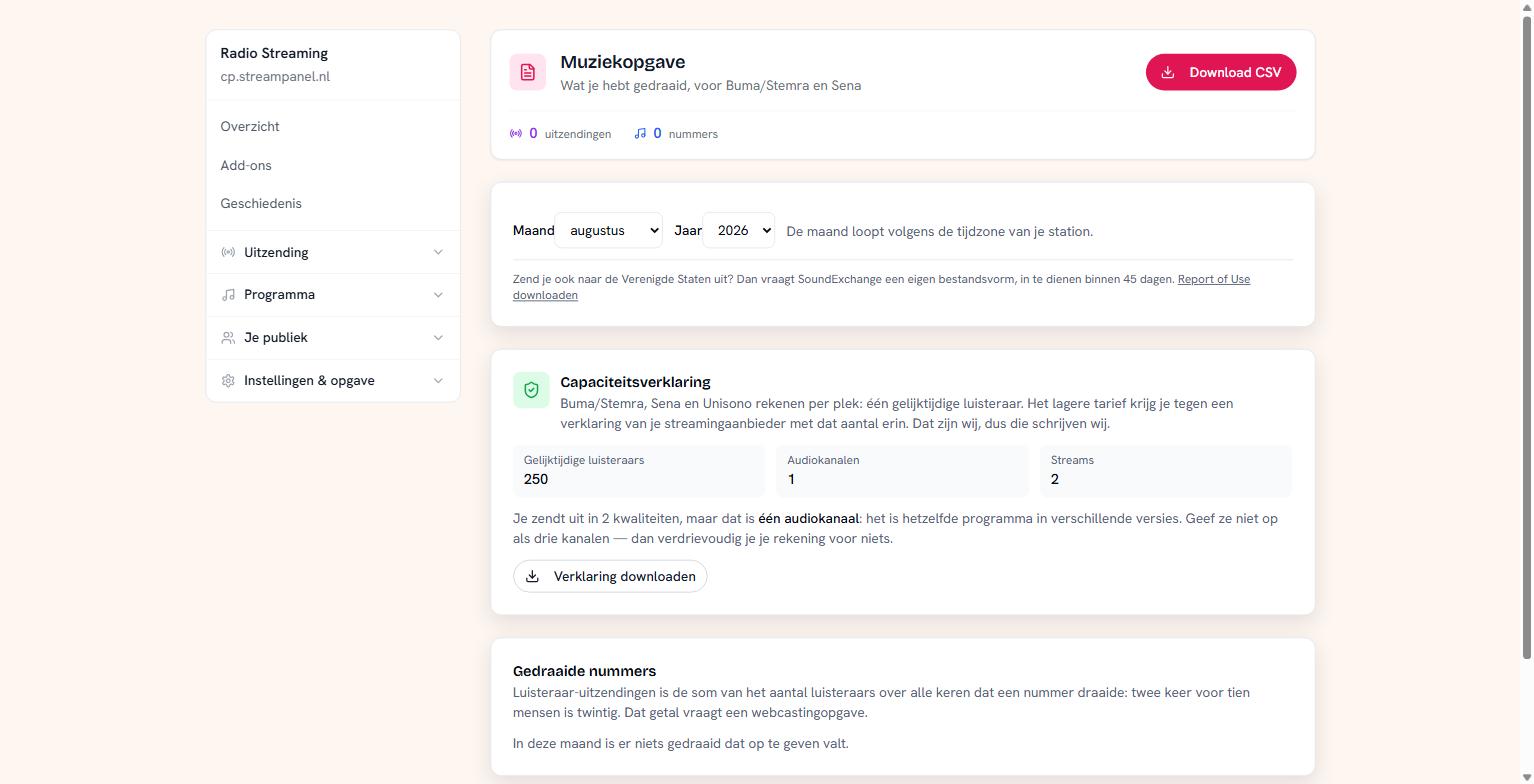 The music report with the capacity declaration
The month
By default you see the previous full month — that's the month you submit. The month runs in your station's time zone, not your browser's.
The file
Download CSV gives you the file in the shape the rights organisation asks for. That file comes straight from the platform rather than from our own formatting, so the format is maintained in one place.
Per track it contains how often it played and how many listener-transmissions that produced. The latter is the sum of the listener count across every time the track played: twice for ten people is twenty. That figure is what a webcasting report asks for.
What's not in it, and why that matters
Broadcasts without an artist or title cannot be reported. Think of a live show where the presenter sends no metadata, or a fallback stream. Those do count in your airtime, but they can't be reported.
That's stated in as many words, deliberately: a report showing only the reportable transmissions is correct on paper but not in reality.
To avoid this, make sure your encoder sends the title during live shows, and that the files in your library have clean artist and title fields. That's the same effort your listener sees in their player.
The capacity declaration
The rights organisations charge per slot: one simultaneous listener. You get the lower rate against a declaration from your streaming provider stating that number — and that's us, so we write it.
Click Verklaring downloaden and you have it.
Watch the audio channels. If you broadcast in several qualities, that's still one audio channel: it's the same programme in different versions. Don't report them as separate channels — you'd multiply your bill for nothing.
Broadcasting to the United States
If you have listeners there, SoundExchange asks for its own file format, to be submitted within 45 days. There's a separate download for that on this page.