Your station broadcasts on one quality by default. With extra streams you offer the same broadcast a second time, encoded differently — lighter for people listening on their phone, for instance.
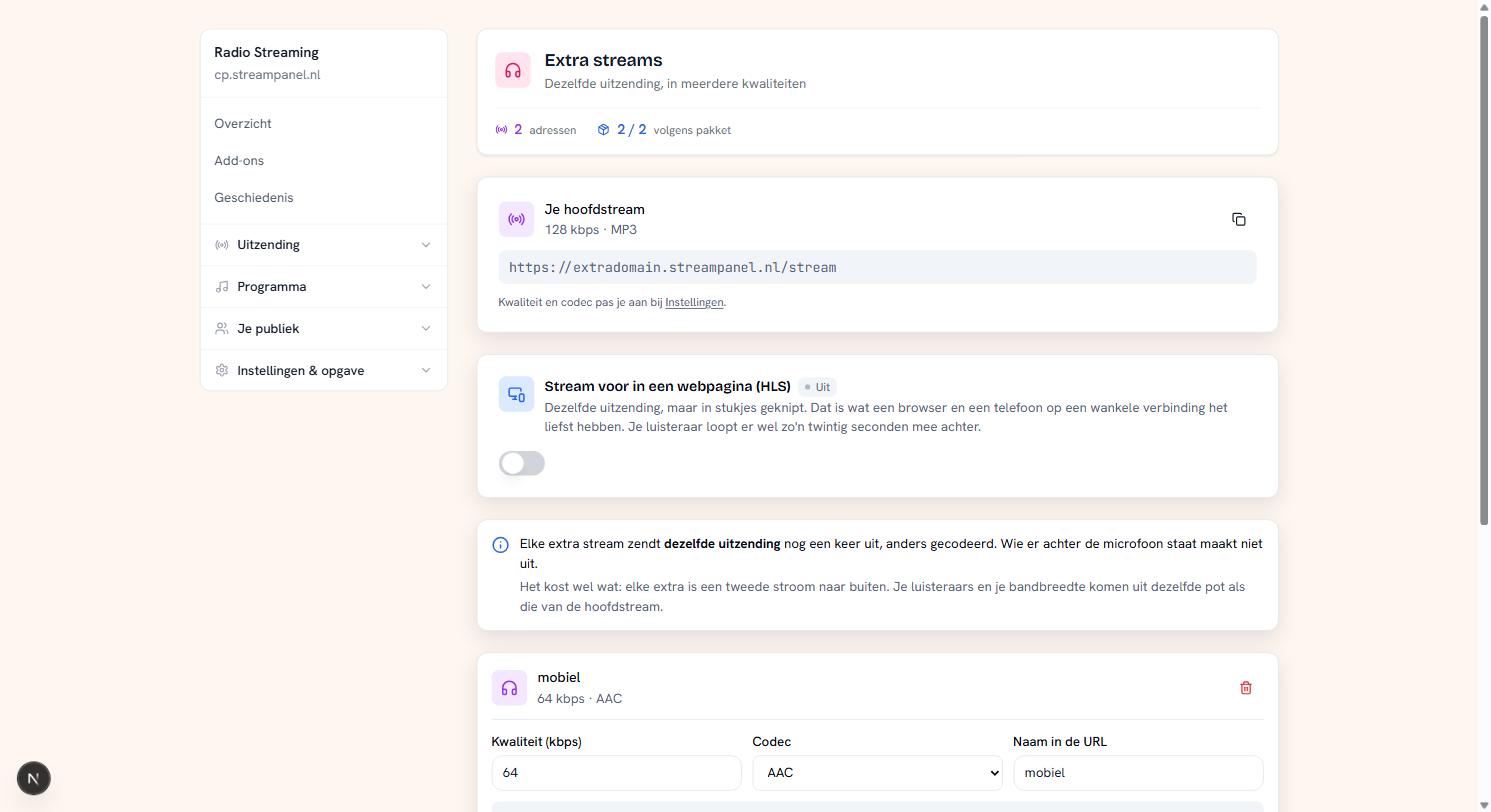 The screen with the main stream, HLS and one extra quality
What an extra stream is and isn't
It is the same broadcast. Who's behind the microphone, which record is playing, when the news comes — that's identical across qualities. Only the encoding differs.
It does cost something. Every extra stream is a second outgoing flow, and your listeners and your bandwidth come from the same pot as the main stream's. Two listeners on the low quality count as two listeners.
How many may you have?
Top right shows how many addresses you have and how many your plan allows. If you're at the limit, that's the moment to check whether every quality still has listeners — your statistics screen shows that per quality.
Setting one up
Per extra stream you choose the quality in kbps, the codec, and the name in the URL. That name goes after your slug, so mobiel produces an address ending in -mobiel.
Choose AAC for low bitrates: at 64 kbps AAC sounds noticeably better than MP3. Above 128 the difference is small and MP3 is more widely supported.
HLS
HLS is the same broadcast, but cut into chunks. That's what a browser on a phone with a shaky connection prefers: if the connection drops briefly, it picks up the next chunk instead of losing the whole stream.
The price is delay. Your listener runs about twenty seconds behind. For music that doesn't matter; for a live match report it does.
A new stream isn't visible right away
Save an extra quality and it takes half a minute before it exists — the node has to set it up. The screen shows that with a progress bar. Reload during that time and the stream seems to have vanished; it just isn't there yet.